Why Car Dealers Need Trustpilot Reviews to Succeed?
The automotive retail industry stands upon a foundation of trust. A vehicle is often the second-most expensive purchase a person makes, involving significant financial commitment, emotional investment, and long-term reliance on the seller. This high-stakes environment means that buyer confidence is not just a nice-to-have; it is the absolute prerequisite for any sale. Historically, this trust was built in the showroom through handshakes, glossy brochures, and the personal rapport of a sales executive.
Today, that dynamic has irrevocably shifted. As noted in a Financial Times report on digital consumer behaviour, over 95% of car buyers now begin their journey online, and their perception of a dealership is solidified long before they set foot on the forecourt. The modern buyer’s first interaction with your brand is not with a salesman, but with your digital reputation—specifically, your online reviews. A dealership with a sparse or negative review profile is digitally invisible or, worse, actively repellant. In this climate, a robust collection of positive Trustpilot reviews has transitioned from a passive feedback channel to an active, essential sales tool. For many dealers, the strategic decision to buy Trustpilot reviews has become a critical component of establishing that vital initial trust and capturing market share in an intensely competitive landscapes.
How Customers Choose a Car Dealer Today
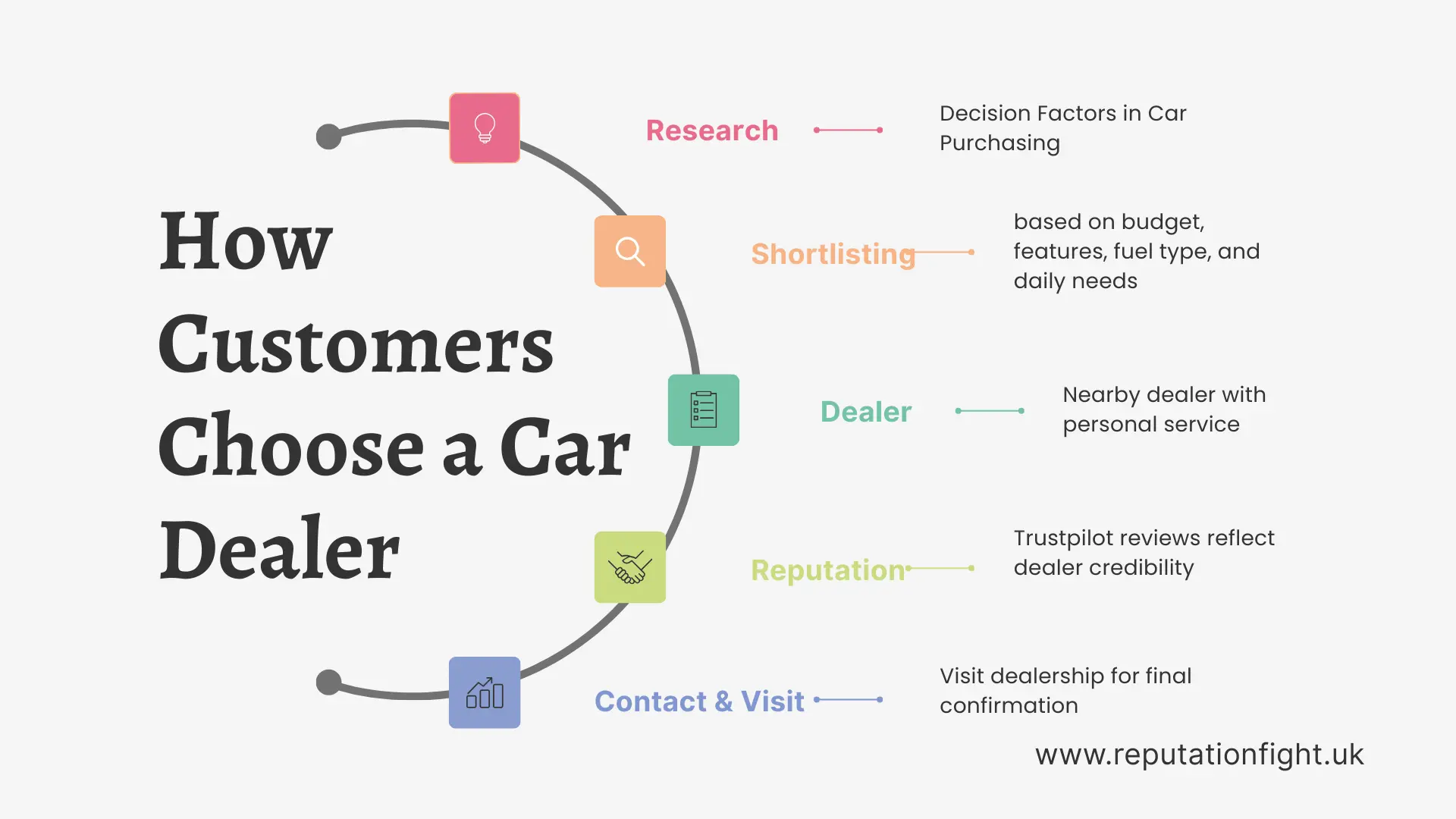
The car-buying funnel has been completely reconstructed by the internet. A customer’s journey typically follows this pattern:
Research & Shortlisting: The buyer identifies makes and models of interest.
Dealer Evaluation: This is the crucial phase where they search for “[Brand] dealership in [City]” or “used car dealer near me.” The search results page displays not just websites, but star ratings and review snippets.
Reputation proof: The buyer clicks on the Trustpilot profile. They filter to read negative reviews first, assessing how the dealer handles complaints. They look for volume, consistency, and recency of feedback.
Contact & Visit: Only after passing this digital “trust check” does the buyer call, submit an online inquiry, or visit the showroom.
A study by BrightLocal confirms that 87% of consumers read online reviews for local businesses, with trust in reviews as high as trust in personal recommendations. For car dealers, this means a poor or empty Trustpilot profile can halt the sales process before it even begins. Trustpilot has emerged as a primary platform for this scrutiny due to its perceived independence (unlike reviews hosted solely on a dealer’s website) and its global recognition.
What Are Trustpilot Reviews and Why They Matter for Car Dealers
Trustpilot is an open, global review platform where anyone can review any business. This openness is a double-edged sword for car dealers. While it allows satisfied customers to sing your praises, it also gives a loud voice to dissatisfied ones. The platform’s credibility stems from its efforts to combat fake reviews, making the ratings displayed powerful social proof.
For a car dealer, these reviews matter profoundly because they speak directly to the core anxieties of the buyer:
Transaction Integrity: “Was the price fair, or were there hidden fees?”
Vehicle Condition: “Was the car as described, or did it have undeclared issues?”
Sales Process: “Was the pressure high or the advice helpful?”
After-Sales Service: “If something goes wrong, will they help me?”
A strong Trustpilot rating (ideally 4.5 stars and above) directly addresses these fears, providing collective reassurance that the dealership operates with honesty and professionalism. This credibility extends beyond mere sales to critical financing and service departments, creating a halo of trust around the entire business.
Why Car Dealers Struggle to Get Reviews Naturally
Despite knowing the importance of reviews, most dealerships find accumulating them organically a slow and frustrating process. Several key barriers exist:
Low Organic Review Rates: The reality is that only a tiny fraction of satisfied customers spontaneously leave a review. The experience, while positive, ends at the handover. Without a persistent, perfectly-timed follow-up system, silence is the default.
Fear of Negative Feedback: This fear often paralyses dealerships from actively soliciting reviews. The concern is that by inviting feedback, they might inadvertently amplify a negative experience from a disgruntled customer, damaging their profile.
Ineffective Solicitation: Relying on a busy sales executive to remember to ask for a review is unreliable. Mass email requests often land in spam or are ignored. Without a seamless, integrated process, review generation stalls.
This creates a catch-22 for new or struggling dealerships: you need reviews to gain trust, but you need trust (and sales volume) to get reviews. This is the fundamental impasse that leads many to consider the option to buy Trustpilot reviews.
Why Car Dealers Need to Buy Trustpilot Reviews
For dealerships facing this impasse, the strategic decision to buy Trustpilot reviews is a market-leveling tactic. It is not about fabricating a false reality, but about accelerating the visibility of your dealership’s true quality. Here’s why it’s considered necessary:
Building Instant Trust for New/Recovering Dealers: A new dealership or one rebranding after a poor reputation period starts with a blank or tarnished slate. To buy 5 star Trustpilot reviews in a steady, gradual manner provides the foundational social proof needed to attract the first wave of cautious customers.
Competitive Necessity: When your direct competitors have hundreds of reviews and you have dozens, you are at a severe disadvantage. Buying Trustpilot reviews allows you to compete on an even footing, ensuring you are not dismissed in the side-by-side comparison that modern buyers inevitably make.
Controlling the First Impression: The digital handshake must be confident. A profile populated with positive, detailed reviews about specific elements—like “no-haggle pricing,” “excellent part-exchange valuation,” or “fantastic after-sales team”—shapes the customer’s perception before any personal contact, making the subsequent sales process smoother and more trusting.
Benefits of Buying Trustpilot Reviews for Car Dealers
The tangible benefits of a robust, review-rich Trustpilot profile directly impact the dealership’s bottom line:
Increased Showroom Footfall and Inquiries: A strong rating improves local SEO, making the dealership appear higher in “near me” searches. More visibility coupled with social proof leads to a direct increase in phone calls, online contact form submissions, and physical visits.
Higher Conversion Rates: A lead that arrives already trusting the dealership is a warmer lead. Sales teams report lower price resistance and shorter sales cycles when the customer’s initial trust barriers have been alleviated online.
Enhanced Brand Authority: A dealership with a 4.8-star rating on Trustpilot is perceived as an authority and a safe choice. This authority allows for more effective (and ethically-used) advertising, as the claims in ads are backed by independent verification.
Improved Marketing ROI: Pay-per-click (PPC) ads for car dealers are expensive. Sending that costly click to a landing page or profile with weak reviews is a wasted investment. A strong Trustpilot profile acts as a “trust bridge,” increasing the conversion rate from every marketing pound spent.
Is Buying Trustpilot Reviews Safe for Car Dealers?
The primary concern for any dealer is risk. The question of safety when you buy Trustpilot review packages hinges entirely on the method.
Common Misconceptions:
“All bought reviews are detected and removed.” This is only true for low-quality services that use fake profiles, identical text, or sudden review bursts. Advanced providers use sophisticated methods to mimic organic behavior.
“It’s completely unethical.” Proponents argue that if a dealership provides good service but suffers from the silent majority problem, buying reviews is a way to accurately represent its standard, countering the vocal minority of negative posters.
Safety is achieved through professional, gradual delivery and maintaining a natural-looking profile that blends purchased and organic reviews.
How Professional Trustpilot Review Services Work for Car Dealers
A professional service tailored for the auto industry operates with nuance:
Realistic Reviewer Profiles: Providers use accounts with history, not empty shells. These “reviewers” may have profiles showing other reviews for local services (restaurants, tradespeople), mimicking real user behavior.
Location & Industry Relevance: Reviews are crafted to sound like they come from local buyers. They mention specific car models the dealer sells, local boroughs, and realistic buying scenarios (e.g., “Upgraded from a Ford Fiesta to a used BMW 3 Series here…”).
Steady, Drip-Feed Delivery: Instead of 100 reviews overnight, a professional service delivers 5-10 reviews per week over months. This mirrors the natural accumulation pattern and avoids detection algorithms that flag sudden spikes.
Content Variety: The service will provide varied language, sentence structure, and focus points—some praise the sales team, others the ease of finance, others the quality of the used car preparation.
Mistakes Car Dealers Should Avoid When Buying Reviews
To buy Trustpilot reviews successfully requires avoiding amateur errors:
Sudden Review Spikes: Adding 50 reviews in a week to a profile with 10 is a guaranteed red flag.
Low-Quality, Repetitive Content: Reviews that all say “Great dealer, good service” are useless and easily spotted. Content must be detailed and varied.
Ignoring Negative Reviews: A profile with only 5-star reviews looks artificial. A professional strategy sometimes includes the strategic placement of a few 4-star reviews for authenticity. More importantly, the dealer must professionally and publicly respond to all genuine negative reviews to show engagement.
Stopping Reputation Management: Buying reviews is an initiator, not a substitute. The dealership must implement a system to capture genuine reviews from real customers to take over the long-term growth of the profile.
How Trustpilot Reviews Help Car Dealers Get More Sales
The sales impact is direct and measurable. When a customer sees a profile filled with verified Trustpilot reviews (or reviews appearing as such), their psychological guard lowers. They enter the showroom or call with a presumption of competence and fairness. This transforms the sales dynamic:
The salesperson spends less time building basic trust and more time focusing on the vehicle.
Price negotiations become less adversarial, as the buyer has a pre-established belief in the dealer’s transparency.
The likelihood of the buyer proceeding with finance and after-sale products from the dealer increases, as the overall trust in the institution is higher.
How Successful Car Dealers Use Trustpilot Strategically
Top-performing dealerships use Trustpilot as an integrated marketing pillar:
The Strategic Blend: They use purchased reviews to build a strong foundation and maintain a high average, while simultaneously implementing a rigorous process (e.g., follow-up SMS systems, dedicated staff) to capture a high volume of genuine reviews from real buyers.
Active Engagement: They respond to every review—thanking for positives and offering solutions publicly for negatives. This public engagement is a powerful trust signal to future readers.
Promotion of Ratings: They display their Trustpilot rating and review snippets prominently on their website homepage, on vehicle listings on their site, in email signatures, and in digital advertising. A Forbes article on digital marketing highlights that showcasing reviews can increase conversion rates on landing pages by over 30%.
Buying Trustpilot Reviews vs. Waiting for Organic Growth
This is the core strategic decision. The car market moves quickly; inventory turns over, and sales targets are monthly.
Organic Growth: Is slow, unpredictable, and biased towards negative experiences. It can take 12-18 months to build a profile that meaningfully impacts sales. In that time, a competitor using a strategic review acquisition can solidify their market position.
Buying Reviews (Strategic Acquisition): Provides a controlled, fast-acting solution. It allows a dealer to establish a competitive profile within 60-90 days, directly influencing lead generation and sales volume during critical trading periods. The time-to-results factor makes it a compelling tool for growth-focused management.
Recommended Way for Car Dealers to Buy Trustpilot Reviews
For a dealer considering this path, a prudent approach is vital:
Start Small & Steady: Begin with a package that delivers 2-3 reviews per week. Monitor their posting and the profile’s performance.
Prioritise Quality & Relevance: Insist on reviews that are specific to the automotive industry, mention local details, and reflect genuine buying concerns.
Choose an Experienced Provider: Select a service that explicitly understands the needs of car dealers. They should be able to discuss FCA compliance nuances, common dealership departments, and typical customer journey points to make reviews convincing.
Plan for the Long-Term: View the initial purchase as “reputation capital” to jump-start the process. Simultaneously, build your internal systems to generate authentic 5-star reviews from delighted customers.
Long-Term Success Strategy for Car Dealers
The ultimate goal is sustainable success. Buying Trustpilot reviews is a tactical entry point into a long-term strategy of trust-based branding. The model for success is:
Use strategically purchased reviews to establish credibility and attract initial customers.
Deliver an exceptional, five-star customer experience to every one of those customers.
Systematically capture their authentic positive feedback, allowing organic reviews to become the primary growth driver of your profile.
Leverage your stellar, trusted reputation to command better inventory, attract better staff, and justify premium positioning, leading to higher profitability and customer loyalty.
Conclusion
In the modern automotive retail environment, a dealership’s Trustpilot profile is its digital showroom window. It must be clean, attractive, and packed with evidence of happy customers. For many, the challenge of populating that window through organic means alone is insurmountable in a commercially relevant timeframe.
The strategic decision to buy verified Trustpilot reviews represents a pragmatic solution to this modern marketing challenge. It is a tool to accelerate the establishment of trust, compete on a level playing field, and capture the sales opportunities that a weak online reputation would otherwise forfeit. However, it is not a silver bullet. Its true power is unlocked only when used as the catalyst for a genuine, customer-centric reputation cycle. The formula for dealership success in the digital age is therefore clear: Smart, strategic review acquisition combined with consistently excellent real-world service equals sustained growth and market leadership. The dealers who understand and implement this formula will be the ones who not only survive but thrive in the increasingly competitive landscape of automotive retail.